
Local Hiring in the UK: What Employers Look for in Candidates
31st Mar 2026
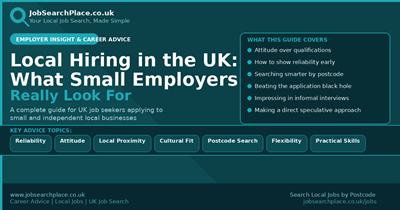
Local Hiring in the UK: What Small Employers Really Look For in Candidates
Understanding the hiring mindset of Britain's small businesses can be the difference between getting shortlisted and being overlooked. This guide uncovers what local employers genuinely value — and how you can position yourself to stand out.
Introduction
Small businesses are the backbone of the British economy. According to the Federation of Small Businesses, there are approximately 5.5 million small businesses in the UK, accounting for over 99 per cent of all private sector firms and employing around 16 million people. Yet despite their enormous contribution to local employment, very little career advice is tailored to help candidates navigate the distinct realities of applying to small employers.
Large companies and their recruitment processes dominate most job-seeking guidance. Applicant tracking systems, structured competency interviews, and five-stage hiring pipelines are the norm in corporate hiring. Small businesses operate very differently. A family-run catering firm in Leeds, an independent retail shop in Truro, or a five-person marketing agency in Bristol each hire with a completely different set of priorities — and candidates who understand those priorities hold a significant advantage.
Whether you are searching for a new role close to home or exploring opportunities in your local area, JobSearchPlace.co.uk connects you with local employers actively looking for candidates who are the right fit. This guide will help you understand exactly what those employers are looking for — so you can present yourself with confidence and clarity.
Why Small Employer Hiring Is Different
When a small employer hires, the stakes are considerably higher than they are for a large corporation. Recruiting the wrong person into a team of five or ten has an immediate and visible impact on morale, productivity, and customer relationships. There is no HR department to cushion the blow, no team buffer to absorb a poor hire, and no lengthy performance management process to soften the exit.
This reality shapes everything about how small employers approach recruitment. They are not simply filling a vacancy. They are bringing someone into their daily working life — often into a space they have built from the ground up. Unlike large organisations, small employers frequently have no dedicated HR function, recruit informally through local networks, and prioritise speed and practicality over structured process.
| Key fact: According to the Office for National Statistics (2026), SMEs account for three-fifths of all employment in the UK private sector and over half of private sector turnover — making small employer hiring the dominant employment experience for the majority of working people in Britain. |
This explains why many roles are not widely advertised, receive fewer but more targeted applications, and are filled quickly once the right candidate emerges. Understanding this distinction is the first step in becoming a stronger candidate for local roles.
Related reading: How to Find Local Jobs Near You in the UK: A Complete Guide — 16 proven strategies for finding local roles, including contacting employers directly and accessing unadvertised opportunities.
Attitude Comes Before Qualifications
Ask any small business owner what matters most in a new hire, and the answer is almost always the same: attitude. This is not a cliche — it reflects a practical reality. Skills can be taught. A bad attitude, a lack of motivation, or a sense of entitlement cannot easily be trained out of someone once they join a small team.
Small employers frequently hire candidates who are slightly underqualified on paper but demonstrate genuine enthusiasm, a willingness to learn, and a proactive mindset. Conversely, highly credentialled candidates who appear disengaged, arrogant, or inflexible are regularly passed over in favour of someone with less formal experience but a more compelling attitude.
| Research insight: The CIPD's Labour Market Outlook (2023) found that 76 per cent of UK employers reported attitude and motivation as the primary determinant of hiring decisions for entry and mid-level roles — outranking formal qualifications by a significant margin. |
This does not mean qualifications are irrelevant. For roles requiring regulated expertise — healthcare, law, accounting, engineering — appropriate credentials are essential. But in the majority of small business roles, a candidate who arrives curious, hungry to contribute, and openly enthusiastic about the work will outperform a more passive candidate with a stronger CV.
In practical terms, this means you should treat every interaction with a small employer as an opportunity to demonstrate your attitude. How you respond to an email matters. Whether you arrive on time matters. The questions you ask at interview matter. Small employers pay close attention to these signals because they reveal character.
Related reading: Job Search Cover Letter Guide — how to write a compelling, professional cover letter that communicates the right attitude from the very first line.
Reliability Is the Quality Small Employers Value Most
If attitude opens the door, reliability is what keeps candidates inside it. Across industries, small employers consistently cite reliability as the single most important trait they look for. This means turning up when expected, completing tasks without needing to be chased, communicating proactively when problems arise, and following through on commitments.
The reason reliability is so prized in small businesses is that there is no redundancy built into small teams. If one person fails to deliver, the gap is immediately felt by everyone else. A delivery driver who calls in sick without warning, a receptionist who consistently arrives late, or a tradesperson who misses appointments all create a disproportionate level of disruption in a business where every role is load-bearing.
| Key fact: The Federation of Small Businesses (2023) reported that poor attendance and unreliability are cited by small business owners as the leading cause of probationary dismissals, ahead of skills gaps and performance issues — underscoring how central reliability is to the small employer hiring decision. |
For many local roles — particularly in retail, care, hospitality, and logistics — punctuality, consistency, and trustworthiness matter more than academic credentials. Demonstrating reliability during the application process itself is one of the most effective ways to build trust. Respond to messages promptly. Arrive to interviews a few minutes early. Send a brief follow-up note after speaking with them. These small, consistent actions signal that you are the kind of person who shows up and follows through.
Local Availability and Proximity
One of the most consistently overlooked factors in local job applications is physical proximity to the workplace. Small employers actively favour candidates who live nearby, can start quickly, and are less likely to experience transport disruptions that affect punctuality or shift coverage.
There is a reason many small employers prefer to hire locally — and it goes beyond convenience. Local candidates often bring an understanding of the area's customer base, a familiarity with local suppliers and routes, and existing connections within the community. For businesses that trade locally, these qualities translate directly into commercial value.
A candidate who grew up in the area, shops locally, or has family connections in the town where a business operates is not just a familiar face. They are someone who understands the context in which the business exists, who is more likely to stay in the role long-term, and who may already have relationships with customers or local networks.
When applying to local businesses, acknowledge your local connection where it is genuine and relevant. Mention your familiarity with the area. Reference your knowledge of local customers or the community. These details may seem minor, but to a small employer building a business with local roots, they carry real weight.
Browse UK local job listings directly at JobSearchPlace.co.uk — UK Local Jobs, where small and independent employers post vacancies to connect with candidates in their area.
Cultural Fit in a Small Team
Cultural fit is a term used widely in recruitment, but it carries particular weight in small business hiring. In a company of six or eight people, personalities interact constantly. There are no separate departments to retreat to, no large open-plan offices to provide anonymity, and no distance between the people who make decisions and the people who carry them out.
Small employers are therefore acutely aware of team chemistry. They are not simply assessing whether you can do the job — they are asking whether they would enjoy working alongside you every day. This makes cultural fit both crucial and delicate. It is not about being likeable in a superficial way. It is about sharing similar working values, communication styles, and professional standards.
Candidates can research cultural fit before applying by looking at the business's social media presence, reading reviews on platforms such as Google or Glassdoor, and paying attention to the language and tone used in job postings. A warm, informal job advert from a small business owner signals a different culture than a formal, structured posting — and your application tone should reflect that.
During interviews, asking thoughtful questions about the team, the working environment, and how the business handles challenges will help you assess fit from your side as well. Small employers appreciate candidates who are clearly evaluating whether the role is right for them, not just hoping to be chosen.
Related reading: 10 Top Job Interview Mistakes and How to Address Them — the errors that most commonly cost candidates the role in interviews, and how to avoid every one of them.
Flexibility and the Ability to Wear Multiple Hats
In a larger organisation, roles tend to be clearly defined. In a small business, the boundaries between roles are far more permeable — and that is not a failing, it is simply the nature of how smaller operations function.
A small employer may hire a receptionist who also manages social media, handles supplier enquiries, and assists with stock control. A junior accountant might find themselves helping to draft client proposals. A warehouse operative might take on delivery runs or assist the business owner with admin during quiet periods.
Candidates who signal flexibility and a genuine willingness to roll up their sleeves are significantly more attractive to small employers than those who appear narrowly focused on a particular job description. This does not mean accepting poor working conditions or an inappropriately broad remit without fair compensation. It means demonstrating that you understand the nature of small business work and are comfortable contributing wherever you are needed.
In your application and at interview, give examples of times you have stepped outside your defined role to support a team or solve a problem. This kind of evidence speaks directly to the versatility that small employers rely on.
Related reading: How to Sell Yourself to Employers — practical guidance on presenting your skills, experience, and personal qualities in the most compelling way.
Practical Skills and Immediate Contribution Over Polished CVs
There is a growing disconnect in UK hiring between the importance placed on polished CVs by candidates and the relatively limited weight many small employers actually give them. While a clear, readable CV is important, small business owners are frequently more interested in what you can actually do than in how well you have formatted your career history.
Unlike large companies with structured onboarding programmes, small employers often need candidates who can start quickly, learn on the job, and add value from day one. This shapes their assessment of every application. A candidate for a graphic design role who brings a small portfolio of relevant local examples will make a stronger impression than one who describes their experience in general terms. A candidate for a bookkeeping role who demonstrates working knowledge of Xero or Sage during the conversation will stand out immediately.
| Research insight: CIPD's Resourcing and Talent Planning Survey (2023) found that 61 per cent of UK small employers rated a candidate's ability to demonstrate practical, on-the-job competence as more influential than CV presentation alone during shortlisting decisions. |
Where practical demonstrations are not possible, specificity matters. Rather than describing yourself as a skilled communicator or an experienced team player, describe a precise situation in which you resolved a communication problem or supported a team through difficulty. Concrete examples carry far more weight than abstract claims — particularly with small business owners who deal in practical realities every day.
Related reading: What Should I Include in a UK CV? The Ultimate Checklist — exactly what small and large employers look for, what to leave out, and how to format for maximum impact.
Understanding the Business You Are Applying To
One quality that consistently separates shortlisted candidates from the rest is a demonstrated understanding of the business. Candidates who show awareness of the company's services, its customers, and its local environment stand out immediately — even when their awareness is basic.
A small employer who has built a business from nothing invests considerable personal identity in it. A candidate who has clearly taken fifteen minutes to look at the website, follow the social media account, and understand what the business does and who it serves signals genuine interest. That signal is far more compelling than any generic statement about being a team player or a fast learner.
Before any application or interview, spend time researching the business specifically. What services or products do they offer? Who are their typical customers? What does their tone and brand communicate about the culture? Are there recent news items, local awards, or community initiatives you can reference? This preparation takes a modest amount of time and delivers a disproportionate return in the eyes of the employer.
Related reading: Can Social Media Be a Helpful Tool in Your Job Search? — how to use social platforms to research employers, build a professional presence, and find unadvertised opportunities.
Why Many Jobseekers Miss Local Opportunities
Despite the volume of local jobs available across the UK, many candidates consistently miss them — not because they lack the skills, but because they are using strategies designed for a different kind of job market.
The most common mistakes include applying broadly on national platforms rather than targeting local roles, using generic CVs and cover letters that make no reference to the specific employer or location, and relying exclusively on large job boards where competition is highest and local relevance is lowest.
| Key fact: According to the ONS Labour Market Overview (2026), the UK recorded over 800,000 live job vacancies in early 2026 — yet employer surveys consistently show that a significant proportion of suitable candidates never see locally advertised roles because they are searching on platforms that do not surface community-level opportunities. |
Speed also matters more in local hiring than many candidates appreciate. Positions at small businesses are often filled within days of being posted. Checking local listings frequently, setting up job alerts, applying early, and following up promptly are practical habits that make a measurable difference to success rates.
Set up a personalised job alert at JobSearchPlace.co.uk — Create a Job Alert so you are notified the moment a relevant local vacancy is posted, giving you the best chance of applying first.
A Smarter Approach to Your Local Job Search
Aligning your job search strategy with the realities of local hiring requires a focused shift in approach. The following steps consistently improve outcomes for candidates pursuing roles with small UK employers.
• Focus on local job platforms. Use platforms designed specifically for community-based hiring, where small employers post directly to reach candidates in their area, rather than relying solely on national boards where your application is one of hundreds.
• Search by postcode rather than city. Entering your postcode rather than a broad town or city name returns results that reflect your actual commute, not just a loose geographical region. City-wide searches regularly surface roles that involve long, inconvenient journeys. Postcode searching narrows results to your immediate community, saving time and travel costs from the outset.
• Set a realistic search radius. Narrow your radius to reflect the distance you are genuinely prepared to travel. Starting tight — even as low as one or two miles for walkable or cycling roles — and expanding from there gives you a clear picture of what is available close to home before widening your options.
• Tailor every application. Personalise each cover letter or introductory message to reference the specific business, its services, and the reason you are genuinely interested in working there. Generic applications are identified immediately and rarely advance.
• Be proactive. Contact employers directly where appropriate, even when no vacancy is advertised. A well-crafted speculative approach to a business you admire can open a door that no job board will surface.
• Apply early and follow up. Local roles move quickly. Applying within the first day or two of a vacancy being posted, and sending a polite follow-up if you have not heard within a week, signals both interest and professionalism.
• Keep your search consistent. Check local listings regularly rather than in periodic bursts. Small employers post and fill roles on their own timescales, which do not always align with when candidates happen to be looking.
Related reading: Find Jobs Near You by Postcode in the UK — a full guide to postcode-based job searching, how to set your radius, and why it produces better results than city-level searches.
Start your targeted local search now: Search for local jobs on JobSearchPlace.co.uk — updated daily with verified vacancies from small and independent employers across the UK.
The Application Black Hole: Why Silence Is So Common and What to Do About It
One of the most demoralising experiences in a job search is sending application after application and hearing nothing in return. This phenomenon — widely described as the application black hole — is consistently reported as the single greatest frustration among UK job seekers, and is particularly prevalent on large national platforms where employer responsiveness is inconsistent and application volume is high.
The silence is not always a reflection of your suitability. In many cases, roles on large boards are filled within days, but the listing remains live for weeks. Other times, small employers receive dozens of unsuitable applications and do not have the time or resource to respond to each one individually. The result is a deeply frustrating experience that erodes confidence and obscures which applications are genuinely under consideration.
There are practical steps you can take to reduce the frequency of this experience. Applying to employers who have a visible track record of communicating with candidates — evidenced through reviews on platforms such as Glassdoor or Indeed — is a good starting point. Applying through local platforms where listings are verified and expired vacancies are removed promptly means you are less likely to be applying for positions that no longer exist.
Following up professionally is always appropriate. If you have applied and not heard back within seven to ten working days, a brief and courteous message to confirm receipt and reiterate your interest is entirely reasonable. It signals continued motivation and gives the employer a prompt to act. The majority of small business owners appreciate this kind of follow-through — it mirrors the very reliability they are seeking in a hire.
Perhaps most importantly, do not allow silence to define your self-assessment. The application black hole is a structural problem in how many job platforms operate, not a verdict on your candidacy. Focusing your energy on local, targeted applications to employers who have demonstrated responsiveness will produce a meaningfully better experience.
Related reading: Tips for Effective Job Search in the UK — practical strategies for cutting through the noise, staying motivated, and applying more effectively to local and national vacancies.
The Power of Personal Recommendations
It is a well-documented reality of small business hiring that a significant proportion of roles are filled through word of mouth before they are ever advertised. A business owner who needs to hire often asks trusted colleagues, existing staff, local business contacts, or suppliers whether they know anyone suitable. A strong personal recommendation from someone the employer already trusts can be worth more than any formal application.
This does not mean the formal application route is fruitless — far from it. But it does highlight the importance of building and maintaining local professional relationships. Attending local business networking events, staying in touch with former colleagues and managers, and making your job search known to people in your network can open doors that no job board will surface.
For candidates re-entering the workforce after a career break, or those looking to pivot into a new sector locally, personal introductions can be particularly powerful. A small employer who might hesitate to invite an unknown candidate to interview will often give a referral a warm and open hearing.
How to Approach a Small Employer Directly
One of the most underused strategies in a local job search is making a direct, speculative approach to a small business you admire or would like to work for. Many small employers never advertise their vacancies because they do not want to be overwhelmed with unsuitable applications. Instead, they wait for the right person to come to them — and a well-crafted, direct approach can be exactly the kind of introduction they respond to.
A direct approach works best when it is specific, personal, and clearly demonstrates that you have researched the business. Mention something you genuinely admire about what they do. Identify a way you could contribute based on what you observe from their website or social media. Keep your message brief and professional, and make it easy for them to respond by being clear about what you are looking for.
This approach requires confidence, but it also demonstrates the kind of initiative and proactivity that small employers find extremely appealing. Even if they have no immediate vacancy, your details may be remembered when a position does become available — particularly if you followed up with a brief, courteous message a few weeks later.
Related reading: What Is a Personal Statement and How to Write It — how to craft a compelling introduction to yourself that works equally well in a speculative letter, an email enquiry, or a formal application.
Common Mistakes Candidates Make with Small Employers
Understanding what small employers value is only half the equation. Knowing what puts them off is equally important. The following are mistakes that candidates repeatedly make when applying to or interviewing with small businesses.
• Sending a generic CV and cover letter that clearly has not been tailored to the business in any way
• Focusing exclusively on salary expectations before demonstrating any genuine interest in the role
• Appearing overqualified but failing to address why a smaller, less senior role is genuinely attractive to them
• Being vague about availability or giving the impression of being difficult to contact
• Asking about holidays and benefits before demonstrating any enthusiasm for the work itself
• Applying for a role in a location far from where they live without explaining their interest in that particular area
• Mentioning previous employers in a dismissive or negative way — a major red flag for a business owner who has invested their identity in their work
• Searching by city rather than postcode, and applying for roles that involve an impractical commute — creating reliability concerns in the employer's mind before the interview has even begun
Small employers often make hiring decisions quickly and on instinct. A single misstep in tone, effort, or approach can close a door that might otherwise have been wide open. Investing a modest amount of additional care in your application and your conduct throughout the process will consistently pay dividends.
What Small Employers Want to See in an Interview
The interview format at a small business is often far less structured than at a large company. Rather than a formal panel interview with predetermined scoring criteria, you may be meeting informally with the business owner, a manager, or the person you would be directly replacing. The conversation may wander across topics you did not expect, and the atmosphere may be deliberately relaxed.
This informality can catch candidates off guard. It should not. An informal interview is still an interview, and small employers are still evaluating you throughout. In fact, the relaxed setting makes it easier for them to assess your natural personality, your communication style, and your levels of self-awareness — all of which matter enormously to them.
Come prepared with a clear and honest account of your career history. Be ready to talk about why you left previous roles without becoming evasive or defensive. Bring genuine questions about the business, the role, and the team — not questions about pay and perks that should come later in the process. Show curiosity. Show enthusiasm. And show that you have done your homework.
If you are offered a tour of the premises or the opportunity to meet other team members, accept it. These moments are not incidental — they are part of the assessment, and participating warmly and naturally in them signals exactly the kind of person a small employer wants to bring on board.
Related reading: 25 Most Common Job Interview Questions and How to Answer Them — fully worked answers to the questions that come up most frequently in UK job interviews, including those used in informal small business settings.
Lived Experiences: What Candidates Wish They Had Known
The following insights reflect common experiences shared by candidates who have successfully navigated small employer hiring in the UK, compiled by the Job Search Place Ltd HR Team.
A candidate based in Hertfordshire had spent several months applying via national job boards with little success. After shifting her focus to local roles — using platforms that surfaced opportunities specifically within her area — and rewriting her applications to emphasise her proximity, her immediate availability, and her genuine interest in local businesses, she secured multiple interviews within two weeks and accepted a position shortly after. The shift was not in her skills or experience; it was in the relevance and targeting of her approach. Local relevance, she found, consistently outweighed broad experience in small employer hiring.
Many candidates who have moved from large corporate environments to small businesses describe the experience as a shift in how they were seen as a person, not just a professional. One former operations manager, who joined a five-person logistics firm in the East Midlands, noted that the business owner asked more questions about her values, her approach to conflict, and her long-term goals than any corporate HR manager ever had. She was offered the role within 24 hours of her interview — largely, she believes, because she had answered every question with complete honesty rather than rehearsed responses.
Another candidate, who joined a small family-run accountancy practice after years in a mid-sized firm, observed that his eventual employer had offered him the role partly because he had sent a follow-up email the day after his interview to share a brief thought on a challenge the business owner had mentioned. That single, unsolicited gesture — taking under ten minutes to compose — demonstrated exactly the kind of thoughtfulness and follow-through the employer was seeking.
These experiences highlight a consistent truth: in small business hiring, the human qualities of a candidate are often more decisive than anything on their CV.
Challenges in Local Hiring and How to Overcome Them
Local job searching carries its own set of challenges that candidates should understand and prepare for. Being aware of these obstacles in advance makes it significantly easier to navigate them.
Limited job visibility is one of the most common difficulties. Many small business roles are never formally advertised. They are filled through internal networks, referrals, or direct approaches before any public posting appears. Candidates who rely solely on browsing advertised vacancies will miss a significant proportion of available opportunities.
Informal recruitment processes can also be disorienting for candidates accustomed to structured corporate hiring. There may be no formal job description, no structured interview, and no clearly defined timeline. Accepting this informality and approaching it with flexibility will serve you far better than trying to impose corporate expectations onto a small business process.
The speed of local hiring is another factor that catches candidates off guard. Positions can be filled within days of being posted. Setting up alerts on relevant local platforms, checking listings daily during an active search, and being prepared to respond and interview at short notice are practical habits that reduce the risk of missing opportunities.
The solutions are straightforward: check local listings frequently, set up job alerts, apply early rather than waiting, and follow up professionally. These habits, applied consistently, make a substantial difference to the volume and quality of responses a candidate receives from local employers.
Related reading: How to Compete in the Labour Market — strategies for standing out in a competitive UK job market, including how to position yourself ahead of other candidates at the application stage.
Case Study: Making the Right Impression with a Small Employer
Consider a practical example. A small family-run bakery in a market town in Yorkshire was looking to recruit an additional member of staff to help manage front-of-house operations — taking orders, serving customers, and maintaining the shop during busy periods. The business owner posted the vacancy briefly online and received around forty applications within a week.
Most applications were generic. Many applicants had applied to dozens of similar roles and their messages made no reference to the bakery, its products, or the local area. A handful of applicants who had clearly visited the shop's social media pages, mentioned specific products they liked, or referenced the bakery's reputation within the town stood out immediately.
The business owner shortlisted four candidates, all of whom had demonstrated some knowledge of and interest in the bakery specifically. Of these, two arrived punctually for their interviews, asked thoughtful questions, and spoke warmly about working in a local, community-facing business. One of them was offered the role the following morning.
The successful candidate had no formal catering qualifications. What she did have was genuine enthusiasm for the business, a warm and natural manner with people, a clear history of reliable employment, and a stated preference for working locally and long-term. For the bakery owner, that combination was everything.
Future Trends in Local Hiring
The landscape of local hiring in the UK is evolving. Several trends are shaping how small employers recruit and what they look for in the years ahead.
Community-based job platforms are growing in influence. As national job boards become increasingly saturated, small employers are moving towards platforms that serve specific regions and communities — improving the quality of candidate matches and reducing the volume of irrelevant applications they receive. Candidates who position themselves on these platforms early will have a structural advantage.
Skills-based hiring is becoming more prominent. Employers are increasingly prioritising practical ability and work readiness over formal credentials. The ability to demonstrate what you can do — rather than simply list what qualifications you hold — will carry growing weight in local recruitment.
Technology-driven matching is improving the efficiency of local hiring. AI-powered tools are making it easier for small employers and local candidates to find each other based on postcode proximity, skills, and availability — reducing the mismatch between where employers are and where suitable candidates are searching.
Digital fluency has become a baseline expectation across almost all small business roles, regardless of sector. A retail assistant who understands basic e-commerce processes, a tradesperson who can manage scheduling software, or an administrator confident with cloud-based tools will consistently be more attractive than candidates who resist digital adoption.
Finally, values-led hiring is on the rise. Candidates who can demonstrate a genuine alignment with a small business's values — whether around sustainability, community engagement, or customer care — are increasingly preferred over those who simply fulfil the technical requirements of the role.
Frequently Asked Questions
Do small employers in the UK care about qualifications?
Many prioritise reliability, attitude, availability, and practical competence over formal qualifications. For regulated professions, appropriate credentials remain non-negotiable. For the majority of small business roles, a candidate who demonstrates genuine capability and commitment will frequently be preferred over someone with formal credentials alone.
How can I stand out to a local employer?
Show that you live nearby, understand the business and what it does, can contribute quickly, and are genuinely motivated by the role rather than simply looking for any available job. Tailor your application specifically to the business, respond promptly to any communication, and demonstrate your character as clearly as your experience.
Why should I search by postcode instead of by city?
City-wide searches often surface roles that are technically within the same region but involve long and costly commutes. Searching by postcode narrows results to your immediate community, ensuring every vacancy you see reflects a realistic journey to work. For a full guide to postcode-based searching, visit Find Jobs Near You by Postcode in the UK on JobSearchPlace.co.uk.
How do I find jobs within walking distance of my postcode?
On JobSearchPlace.co.uk, you can enter your full postcode and set your search radius to reflect only the distance you are genuinely prepared to travel. The Find Jobs Near You by Postcode guide explains exactly how to do this — including how to filter by proximity and surface roles within easy walking or cycling distance.
What should I do if I apply and hear nothing back?
Wait seven to ten working days and then send a brief, professional follow-up message. Silence does not always mean rejection. Applying through local platforms where listings are verified and kept current also reduces the risk of applying for roles that have already been filled. See our guide: Tips for Effective Job Search in the UK for practical strategies on staying visible and motivated throughout your search.
Is it worth applying to a small business if there is no advertised vacancy?
Yes. Many small employers hire through speculative approaches because they never formally advertise their roles. A well-written, personalised direct enquiry to a business you are genuinely interested in can open a door that would not exist through a job board. Keep your message brief, specific, and focused on what you can contribute.
How important is it to live locally when applying for small business roles?
For most roles in retail, hospitality, trades, and care, living locally is a significant advantage and sometimes a practical requirement. Local candidates are perceived as more reliable, less likely to leave for logistical reasons, and more connected to the business's customer community.
Where can I find local jobs at small businesses near me?
VisitUK Local Jobs on JobSearchPlace.co.uk to browse verified vacancies from small and independent employers across the UK, searchable by location, sector, and proximity to your postcode. You can also set up a personalised job alertto be notified as soon as relevant new roles are posted in your area.
How long does small employer hiring usually take?
Small employers often move quickly once they have found a candidate they like. It is not unusual for a hiring decision to be made within 24 to 48 hours of an interview. Being prompt, available, and responsive throughout the process will serve you well.
Do small businesses pay less than large companies?
Pay varies considerably across small businesses and is not universally lower than large employer rates. Some small businesses offer competitive salaries combined with a more flexible, personal working environment. The overall package — including working culture, autonomy, and job satisfaction — often compares favourably with larger organisations once the full picture is considered.
Conclusion
Local hiring in the UK is shaped by practical needs rather than formal processes. Small employers are not looking for the most impressive CV in the pile. They are looking for someone they can trust, rely on, and work alongside productively and harmoniously — someone who understands their business, is available and close to hand, and can contribute without a lengthy runway.
Candidates who understand this — and who invest in demonstrating their attitude, reliability, local connection, and genuine interest in the business — will consistently outperform those who approach small business applications with a corporate mindset. The shift required is not a dramatic one. It is a matter of relevance, care, and targeted effort.
That same principle applies to how you search. Searching by postcode rather than city, applying through local platforms where employers are verified and listings are current, and following up professionally when you do not hear back are habits that compound over time into a meaningfully better search experience and a higher rate of genuine responses.
The UK's small business sector offers outstanding opportunities for candidates at every stage of their careers. By adjusting your approach to match the way these employers think and hire, you reduce competition, increase interview opportunities, and put yourself in a far stronger position than most of the field.
Start your local job search today at JobSearchPlace.co.uk — and explore our full Career Advice library for guides, tips, and resources to support every stage of your job search.
References
Federation of Small Businesses (2023) Small Business Statistics. Available at: https://www.fsb.org.uk/uk-small-business-statistics.html [Accessed: March 2026].
Office for National Statistics (2026) Vacancies and Jobs in the UK: February 2026. Available at: https://www.ons.gov.uk [Accessed: March 2026].
Office for National Statistics (2026) Labour Market Overview, UK. Available at: https://www.ons.gov.uk [Accessed: March 2026].
UK Government / Department for Business and Trade (2024) Business Population Estimates for the UK and Regions. London: HMSO. Available at: https://www.gov.uk [Accessed: March 2026].
CIPD (2023) Labour Market Outlook. London: Chartered Institute of Personnel and Development.
CIPD (2023) Resourcing and Talent Planning Survey. London: Chartered Institute of Personnel and Development.
British Chambers of Commerce (2023) Workforce Survey: Recruitment and Retention Challenges for Small and Medium Enterprises. London: BCC.
Indeed Hiring Lab (2023) UK Labour Market Insights: Small Business Hiring Trends. London: Indeed.
Glassdoor Economic Research (2022) How Small Businesses Hire: Candidate Experience and Employer Priorities. San Francisco: Glassdoor.
GOV.UK (2020) Search Engine Optimisation (SEO) for Data Publishers: Best Practice Guide. Available at: https://www.gov.uk/government/publications/ [Accessed: March 2026].
About the Authors
This article is a collaborative work prepared by the Job Search Place Ltd HR Team. The HR Team at Job Search Place Ltd brings together professionals with collective experience across UK recruitment practice, local employer relations, candidate support, and employment market research. Their work informs the career advice, employer insights, and practical guidance published across JobSearchPlace.co.uk — all designed to give UK job seekers a meaningful advantage in their local search.
Author: Job Search Place Ltd HR Team (Collaborative Work)
Published on JobSearchPlace.co.uk — Your Local Job Search Made Simple