
Find Jobs Near You by Postcode in the UK
31st Mar 2026
Find Jobs Near You by Postcode in the UK: A Smarter Job Search Strategy
Introduction
Searching for work in the UK can feel like a full-time occupation in itself. In the current economic climate, where the cost of living remains a primary concern and commuting expenses can significantly erode a monthly take-home salary, a smarter approach to the job hunt is no longer optional — it is essential.
While national job boards offer a vast volume of listings, they often lack the granular detail required for a truly efficient search. The traditional approach — typing broad terms such as 'jobs UK' or 'vacancies near me' — frequently produces overwhelming and irrelevant results, attracting hundreds of applicants to the same roles and making it harder for genuinely suitable local candidates to stand out.
By shifting your focus to a postcode-led strategy, you can drastically reduce your time-to-hire and ensure your next career move is both sustainable and genuinely local. JobSearchPlace.co.ukis built around exactly this principle — connecting local employers with local jobseekers through postcode-anchored search. This guide explains how to use the technique across every tool available to you.
Why Postcode-Based Job Search Works in the UK
The Current UK Labour Market Context
The UK job market is characterised by a shift towards hyper-locality. According to data from the Office for National Statistics, the national vacancy rate has remained broadly flat at approximately 721,000 open positions, while competition for roles in specific sectors — including health, social care, and professional services — continues to be significant. In that environment, candidates who apply to the most relevant roles, rather than the most roles, consistently perform better.
Most generic searches for 'jobs in London' or 'jobs in Manchester' cast too wide a net. A postcode-led search allows you to bypass the noise, focusing your effort on roles that are genuinely accessible, less competed, and aligned with your daily life.
Localised Hiring Patterns
Many UK employers, particularly small and medium-sized enterprises, prioritise candidates who live nearby, can start quickly, and have minimal commuting constraints. Data from the Office for National Statistics confirms that local labour markets play a significant role in employment outcomes, especially in sectors such as retail, care, logistics, and hospitality. Postcode searching allows you to target realistic commuting zones, access locally advertised roles, and compete with a smaller applicant field.
Why National Boards Disadvantage Local Candidates
Major corporations often dominate the front pages of national job boards because they have the budget for featured or sponsored listings. However, the UK economy is powered by small and medium-sized enterprises that frequently recruit within their immediate vicinity to improve staff retention. These local employers — business hubs, industrial estates, independent agencies, and growing regional firms — are the hidden gems of the local market. They rarely appear prominently on national platforms, but they are exactly the kind of employer that postcode-based searching surfaces reliably.
What Is a Postcode Job Search Strategy?
A postcode job search focuses on specific geographic areas — your home postcode, nearby districts, and areas within a practical commuting distance. Rather than searching 'jobs in London', a smarter approach is entering your full postcode into a platform such as JobSearchPlace.co.uk and setting a radius that reflects your real daily commute tolerance.
Understanding Outward Code versus Full Postcode Searches
A standard UK postcode consists of an outward code — such as EN8 or SW1 — which identifies a broad postal district, and a full postcode such as EN8 9JL or M4 1HQ, which pinpoints a precise delivery zone. When you enter a full postcode, radius searches are centred on that exact point, producing accurate distance-ranked results. When you enter only the outward code, the search centres on the approximate midpoint of the entire district — which in large or rural districts can shift the starting point by several miles. Always use your full postcode where the platform supports it.
Understanding the Economic DNA of Your Postcode Area
Different postcodes have different economic characteristics. A search in NG1 — central Nottingham — may reveal a concentration of creative agencies, digital studios, and tech companies. A search in S9 — east Sheffield — is more likely to surface logistics, advanced manufacturing, and distribution roles. Understanding the sectoral profile of your local postcode helps you target the right opportunities rather than simply applying where volume is greatest. If your home postcode does not yield sufficient results, identify the nearest economic hub in your sector and run a second postcode search anchored there.
The Real Cost of Commuting: Understanding the Commute Tax
One of the most compelling reasons to search by postcode is financial. With rail fares and fuel costs continuing to fluctuate, a job that pays two thousand pounds more per year but requires a forty-five minute train journey each way may actually leave you worse off in real terms than a local role. The additional salary is absorbed by season tickets, fuel, parking, and the hours spent travelling.
When you search by full postcode with a strict radius setting of two, five, or ten miles, every result you see is a viable option for your daily life. You are not simply finding a job — you are protecting your real-term earnings. Candidates who work closer to home consistently report reclaiming several hours of personal time each week, a benefit that carries more practical value than a marginal pay increase in a distant city.
UK Job Platforms: Postcode Search Feature Comparison
Not all job boards handle postcode-based searching in the same way. The table below summarises the key features across the main UK platforms to help you choose the right combination for your search.
| Platform | Full Postcode | Radius Filter | Map View | Job Alerts | Best For |
| JobSearchPlace.co.uk | ✓ | ✓ | ✓ | ✓ | UK local jobs, all sectors |
| Indeed UK | ✓ | ✓ | Partial | ✓ | High-volume, broad search |
| Reed.co.uk | ✓ | ✓ | – | ✓ | Professional & public sector |
| Totaljobs | ✓ | ✓ | – | ✓ | Trades, engineering, logistics |
| CV-Library | ✓ | ✓ | – | ✓ | Alert setup, CV matching |
| Adzuna | ✓ | ✓ | ✓ | ✓ | Aggregated listings, map view |
| Find a Job (Gov.uk) | ✓ | ✓ | – | ✓ | Entry-level, public sector |
| LinkedIn Jobs | Partial | ✓ | – | ✓ | Professional & white-collar |
Key: ✓ = fully supported Partial = limited support – = not available. Verified as of the last review date shown above.
For the most direct postcode-based search experience on a UK-focused platform, begin your search at JobSearchPlace.co.uk. Enter your full postcode, select your radius, and browse roles ranked by proximity to your location.
Step-by-Step Guide to Finding Jobs by Postcode
Step 1: Define Your Core Postcode Area
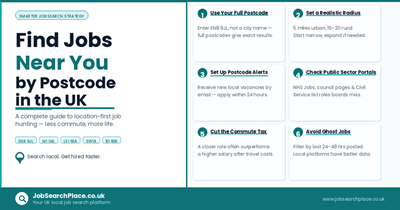
Start with your home postcode and the nearby districts within a realistic commute. A jobseeker in Enfield might target EN1, EN2, N9, and N18. A five-mile radius is typically the sweet spot for a low-stress daily commute in most UK urban areas. Build your initial search around this core, then expand incrementally if the volume of relevant results is insufficient.
Step 2: Use Postcode Filters on UK Job Platforms
The platforms listed in the comparison table above all support postcode-based location searching. Use them in combination to ensure you see the full picture of what is locally available. For UK-wide local job searches across all sectors, start with:
• JobSearchPlace.co.uk — UK Local Jobs — purpose-built for local postcode searching across all sectors.
• JobSearchPlace.co.uk — Search for Jobs — enter your full postcode and set your preferred radius directly.
• Find a Job (GOV.UK) — free Government service with strong coverage of entry-level and local roles.
Step 3: Search by Sector Using Your Postcode
Combine your postcode anchor with specific sector categories to narrow results to what is genuinely relevant. JobSearchPlace.co.uk organises vacancies by sector, allowing you to search locally within a defined category. Sectors with strong local postcode demand include:
• Healthcare and Medical Jobs — includes NHS-adjacent and private healthcare roles across the UK.
• Social Care Jobs — consistently high local demand in all areas.
• Transport and Logistics Jobs — ideal for postcode-based searching given proximity requirements.
• Retail and Consumer Products Jobs — strong local availability in all UK postcodes.
• Construction Jobs — site-based roles that are inherently location-specific.
• Teaching Jobs — school and college-based roles where local proximity is highly valued.
• Hospitality and Tourism Jobs — local availability in every UK town and city.
• Public Sector Jobs — council, government, and public services roles by location.
Step 4: Add Micro-Industry Keywords to Your Postcode Search
Rather than searching only within the location field, add your outward code to the keyword field as well. Searching 'Care Assistant EN3' or 'Project Manager LS1' forces the algorithm to prioritise geographically relevant matches. If your skills transfer across job titles, run separate searches for each relevant title from the same postcode anchor.
Step 5: Sort Results by Most Recently Posted
Always sort your search results by the most recently posted. In a competitive local market, being among the first ten applicants for a role significantly increases your chance of receiving an interview invitation. Many local roles fill quickly, and applying within twenty-four to forty-eight hours of a vacancy going live is a meaningful practical advantage.
Step 6: Verify Commute by Transport, Not Just Distance
A role three miles from your postcode may be harder to reach reliably than one six miles away if transport links are poor. Once you identify roles within your radius, check each employer's address using Google Maps, Citymapper, National Rail, or Moovit before deciding whether it falls within your genuine catchment.
Step 7: Apply Strategically and Highlight Your Proximity
When applying for local roles, make your location work for you. Highlight your proximity to the workplace in your cover letter, emphasise your ability to start quickly, and demonstrate practical knowledge of the area where appropriate. Including your postcode — or at least the outward code — on your CV is also recommended. Many local employers and recruiters filter shortlists by proximity before reviewing experience, so a visible local postcode can influence whether you are considered at all.
Before applying, ensure your candidate profile on JobSearchPlace.co.uk is complete and includes your postcode and distance preferences. A complete profile allows local employers to find you through the platform's Post Your CV feature, meaning opportunities may come to you as well as through your own searching.
Setting Up Postcode-Based Job Alerts That Work
Reactive searching — logging in and running a manual search when you remember to — is one of the least effective job search habits. The candidates who find local work quickly are those who have automated alerts delivering new vacancies to their inbox the moment they are posted.
• Create a Job Alert on JobSearchPlace.co.uk: Set up your postcode-anchored alert here — enter your full postcode, your preferred radius, and your target role or sector.
• Use your full postcode as the location anchor rather than a town or city name for maximum accuracy.
• Set a radius that reflects your genuine daily commute tolerance, not your theoretical maximum.
• Create separate alerts for each relevant job title if your skills transfer across roles.
• Set alert frequency to daily for active searches, or to immediate notification to be among the first applicants.
• Review and revise alerts every two weeks — remove those returning irrelevant results and refine keywords accordingly.
Combining alerts from JobSearchPlace.co.uk alongside alerts from Reed, CV-Library, and Indeed ensures you see a broad pool of local postings without needing to log into multiple platforms throughout the day.
Local Council and Public Sector Job Portals by Postcode
One of the most significant gaps in standard job search advice is the near-total omission of public sector portals. Local councils, NHS trusts, schools, fire services, and other public bodies frequently advertise vacancies on their own websites or through dedicated platforms — and these roles rarely appear on commercial job boards.
• Public Sector Jobs on JobSearchPlace.co.uk — browse public authority and government roles listed with location filtering.
• Visit your local council's website directly and locate its jobs or vacancies section. Most councils advertise roles from entry level through to senior management before they reach commercial platforms.
• NHS Jobs (jobs.nhs.uk) allows full postcode entry and radius filtering across all NHS vacancies in England, Scotland, and Wales.
• Teaching Vacancies (teaching-vacancies.service.gov.uk) supports postcode-based filtering for teaching and support staff roles in state schools.
• Civil Service Jobs (civilservicejobs.service.gov.uk) lists roles across regional offices throughout the UK and can be filtered by location.
Targeting Recruitment Agencies in Your Postcode Area
Regional agencies often have deeper connections with local employers, stronger knowledge of local hiring patterns, and a genuine incentive to place you quickly. To find agencies operating near your postcode, search Google using your outward code alongside the term 'recruitment agency'. Use the Recruitment and Employment Confederation (REC) agency finder to search by postcode and sector specialism, and check local business directories such as Yell for agencies listed by area.
When registering with a local agency, also register your CV on JobSearchPlace.co.uk to ensure local employers and agency recruiters who search the platform can find your profile directly.
LinkedIn and Local Job Searching by Postcode
LinkedIn's job search function supports location filtering by postcode or local area. Several techniques make it more effective for postcode-based searching:
• Use the 'On-site' location filter to exclude fully remote roles if you specifically want work that requires a regular commute.
• Set LinkedIn job alerts with your postcode or local area as the location anchor to receive daily vacancy updates.
• Search for companies using the LinkedIn Companies directory, filter by location, and visit their career pages directly.
• Use the Alumni tool to identify people from your educational background working within your postcode radius, which can open doors for referrals and informal introductions.
• Follow local businesses in your sector and watch for hiring announcements in your feed, which often appear before formal listings are published.
Researching Local Employers Proactively Using Postcode Data
A postcode-based job search does not have to be reactive. You can use postcode data to identify employers in your area before they advertise and position yourself ahead of the competition with a well-timed speculative application.
• Companies House allows you to search for registered businesses by postcode — showing which companies are active locally, their industry, size, and financial standing.
• Google Maps can be searched by business type and location — for example 'marketing agencies near EN8' — surfacing local employers not found on any job board.
• Local Business Improvement District (BID) websites often list member businesses by area and reveal employer concentrations that commercial platforms do not reflect.
The How It Works page on JobSearchPlace.co.uk explains how the platform's candidate profile and CV upload features allow local employers to discover you proactively, complementing your own outbound searching.
Real-World Insight: A Lived Experience
A jobseeker based in North London initially applied for roles across Greater London with limited success. After switching to a postcode-focused strategy — targeting roles within a five-mile radius of their home postcode — they reduced application volume, increased interview invitations, and secured employment within four weeks. Beyond the employment outcome, they reported gaining several hours of personal time back each week by eliminating a long daily commute — a benefit that proved as significant as the role itself in terms of overall quality of working life.
This reflects a consistent pattern: relevance and proximity often matter more than volume. Applying for fewer roles that are genuinely accessible and well matched to your profile consistently outperforms scattering applications across an impractical geography.
Challenges of Postcode Job Searching and How to Overcome Them
The Ghost Job Problem
Ghost jobs — listings that have already been filled but remain active to collect CVs — distort local results and waste application effort. The most effective defence is to filter results by posting date, focusing on roles added within the last twenty-four to forty-eight hours. Local and specialist platforms such as JobSearchPlace.co.uk tend to have higher listing accuracy than global aggregators.
Sparse Results in Rural Postcodes
If you live in a rural area, postcode-based searches will return fewer results by definition. Use a wider radius setting from the outset and supplement digital searching with a proactive direct employer approach, focusing on local councils, NHS trusts, and larger rural businesses such as agricultural suppliers, logistics hubs, and food production facilities.
Inaccurate Distance Calculations
Some job boards calculate distance as the crow flies rather than by road or rail. A role appearing five miles away may require a twelve-mile road journey. Always cross-reference distances against a commute time tool before treating a role as falling within your genuine catchment.
Poor Public Transport Links
A role three miles from your postcode may be unreachable without a car if no direct bus or tram route exists. Before applying, check the public transport links between your home postcode and the employer's postcode using Citymapper, Moovit, or the relevant regional transport planner.
Remote Roles Inflating Local Results
Many roles flagged with a UK-based postcode are effectively remote positions listed with a nominal office location. Use the on-site or hybrid filter on platforms that offer it to separate genuinely local roles from those that carry a postcode but do not require regular attendance.
Fragmented Listings and Duplicate Postings
The same vacancy may appear on several boards simultaneously. Tracking applications carefully and checking whether a role was originally posted on the employer's own website prevents duplicate applications and wasted effort.
Overlapping Postcode Boundaries
Some roles may fall just outside your chosen radius due to how postcode boundaries are drawn. Use multiple postcode variations for your area, expand your radius incrementally, and supplement digital searching with local networking, which surfaces opportunities that never reach any job board.
Opportunities Created by Postcode Job Search
Searching by postcode reshapes the quality of your results in ways that translate into real hiring advantages. Roles discovered through postcode searching tend to attract fewer applicants, involve faster hiring processes, and reach employers actively looking for someone local. You also gain access to vacancies that are short-lived or fill quickly through word of mouth before being widely indexed on national platforms.
There is also a broader opportunity frequently overlooked. Working closer to home — which postcode searching makes achievable — reclaims hours that would otherwise be spent commuting. In a labour market where flexibility and work-life balance have become primary priorities for a growing proportion of UK workers, finding a good role within a short distance of home is an advantage worth pursuing systematically. Explore all UK local jobs on JobSearchPlace.co.uk to see the full breadth of what is available near you.
Future Trends in Local Job Search
Hyper-Local Recruitment
Employers are increasingly targeting candidates within specific geographic zones, driven by the need for reliable attendance and reduced onboarding friction. Hyper-local recruitment platforms focused on specific towns, boroughs, or postcode districts are growing in number, attracting employers who prefer not to pay for national advertising and often surfacing vacancies that larger boards miss.
AI-Driven Local Matching
Artificial intelligence is being integrated into job board platforms to move beyond simple radius matching. AI-driven platforms are beginning to rank results by a combination of proximity, commute time, role relevance, and candidate profile match — a significant improvement in result quality that rewards candidates who have already built postcode-based search habits.
Growth of Community-Based Job Platforms
Local job platforms are playing an increasingly important role in supporting regional employment. The integration of job searching with mapping tools is deepening, and major search engines are expanding their job functionality to surface results with commute-time overlays as a primary filter. Building postcode-based search habits now places you ahead of this curve.
Frequently Asked Questions
How do I search for jobs by postcode in the UK?
Use job platforms that allow postcode or radius-based filtering and enter your full postcode rather than a town or city name. JobSearchPlace.co.uk, Indeed, Reed, CV-Library, Totaljobs, Adzuna, and the Government's Find a Job service all support postcode entry. A full postcode produces more accurate, proximity-ranked results than using only the outward code.
What is the best radius to set for a UK job search by postcode?
For most urban areas, a five-mile radius is the ideal starting point. For rural areas, fifteen to twenty miles may be necessary. Setting the radius too wide — for example, fifty miles — often results in roles that are unsustainable for long-term employment. Start narrow and expand only until you have a sufficient volume of genuinely relevant results.
How accurate are postcode searches for finding remote or hybrid jobs?
Postcode searching remains valuable even if you are open to remote working. Many organisations that offer remote or hybrid arrangements still prefer candidates to be within a reasonable distance of a regional office for occasional team meetings or equipment collection. Searching by your home postcode surfaces these hybrid-remote opportunities alongside fully on-site roles.
Should I include my postcode on my CV?
Yes. Including your full postcode or at least the outward code on your CV signals to local employers that you are nearby talent — a practical priority for roles requiring reliable daily attendance. Many hiring managers filter candidate shortlists by location before reviewing experience, so a visible local postcode can influence whether you are considered for locally advertised roles.
Is postcode job searching more effective than standard searching?
In most cases, yes. It reduces competition, increases result relevance, and positions your proximity as a selling point. It is particularly effective for roles requiring immediate availability or shift-based working, and surfaces vacancies that are advertised locally and never reach the largest national boards.
Do employers prefer local candidates?
In many sectors, yes. Local candidates are often seen as more reliable, easier to onboard, and less likely to leave due to commute fatigue. Mentioning your proximity in a cover letter or interview is a legitimate practical advantage, particularly for roles with early starts, late finishes, or shift patterns.
Can I find jobs without experience using postcode search?
Yes. Local sectors such as retail, care, hospitality, warehousing, and cleaning frequently hire based on availability and attitude rather than formal qualifications. Browse temporary and immediate start roles on JobSearchPlace.co.uk to find locally available entry-level opportunities near your postcode.
Why am I getting very few results for my postcode?
Sparse results typically indicate one of three things: the radius is too narrow, the keyword combination is too restrictive, or the local labour market for your target role is limited. Try widening the radius, broadening your keywords, or searching for alternative job titles that cover similar skills. Also check public sector portals and use your nearest economic hub postcode as an alternative anchor.
Are remote jobs included in postcode-based results?
They can be. Many remote roles carry a company postcode and surface in local radius searches. Use the location type filter on platforms that offer it, selecting on-site or hybrid, to reduce the number of fully remote roles appearing in your results.
How do I avoid ghost jobs when searching by postcode?
Filter your results by posting date and focus on roles added within the last twenty-four to forty-eight hours. Local and specialist platforms tend to have higher listing accuracy than global aggregators. If a role appears on multiple boards with different posting dates, check the employer's own career page to verify it is still live before investing time in an application.
How do I find public sector jobs near my postcode?
Use dedicated portals: NHS Jobs for health sector vacancies, Teaching Vacancies for school-based roles, Civil Service Jobs for government positions, and your local council's careers page for authority roles. Also browse public sector jobs on JobSearchPlace.co.uk for an aggregated view of publicly listed authority and government roles near you.
Conclusion
The approach of applying for every available role across the UK is an outdated and inefficient strategy. The successful job seeker today treats their search with precision — targeting accessible opportunities, applying early, and presenting proximity as a professional asset rather than an afterthought.
Postcode-based job searching is a straightforward, practical strategy that any jobseeker can apply immediately using tools that already exist on the platforms they already use. By anchoring your search to your home postcode, you are not simply looking for a job — you are looking for a role that respects your time, protects your real-term earnings, and fits the life you actually live.
Begin with your full postcode, build your search outward from there, and let geography work in your favour. Start your smarter postcode-led search on JobSearchPlace.co.uk today.
Content Metadata
Meta Title:
Meta Description:
Meta Keywords:
References
1. CIPD (2023) Labour Market Outlook. London: Chartered Institute of Personnel and Development.
2. Department for Work and Pensions (2024) Find a Job. Available at: https://www.findajob.dwp.gov.uk (Accessed: various).
3. Department for Education (2024) Teaching Vacancies. Available at: https://teaching-vacancies.service.gov.uk (Accessed: various).
4. Cabinet Office (2024) Civil Service Jobs. Available at: https://www.civilservicejobs.service.gov.uk (Accessed: various).
5. Huntress Group (2024) UK Job Market Outlook: Office, Finance and Business Roles. Available at: https://www.huntress.co.uk (Accessed: various).
6. JobSearchPlace.co.uk (2024) Local Jobs Near You by Postcode. Available at: https://www.jobsearchplace.co.uk (Accessed: various).
7. LinkedIn Corporation (2024) LinkedIn Jobs. Available at: https://www.linkedin.com/jobs (Accessed: various).
8. NHS Business Services Authority (2024) NHS Jobs. Available at: https://www.jobs.nhs.uk (Accessed: various).
9. Office for National Statistics (2024) Labour Market Overview: UK. Newport: ONS. Available at: https://www.ons.gov.uk.
10. Office for National Statistics (2024) Vacancies and Jobs in the UK. Newport: ONS. Available at: https://www.ons.gov.uk.
11. Recruitment and Employment Confederation (2024) UK Recruitment Industry: Status Report. London: REC.
12. Reed Specialist Recruitment (2024) Reed.co.uk Job Search. Available at: https://www.reed.co.uk (Accessed: various).
13. Royal Mail Group (2024) Postcode Finder. Available at: https://www.royalmail.com/find-a-postcode (Accessed: various).
About the Authors
This article was researched and written by the JobSearchPlace.co.uk Editorial and Content Team — a group of UK employment specialists, career guidance professionals, and digital content writers with direct experience across UK recruitment, career services, and job search platform development.
The team draws on hands-on experience working with UK jobseekers across a wide range of sectors and regions, knowledge of the UK labour market gained through daily work with job listings data and employer relationships, and expertise in search engine optimisation and digital content for employment platforms.
JobSearchPlace.co.uk has been helping UK jobseekers find local work since its founding and operates as an independent, UK-focused job search platform dedicated to connecting local employers with local candidates across all sectors and experience levels.
For career guidance and job search resources, visit the Career Advice section on JobSearchPlace.co.uk. To begin searching for local roles near your postcode, visit the
Author: JobSearchPlace.co.uk Editorial and Content Team
Published on JobSearchPlace.co.uk — Your UK job search resource for local employment opportunities.